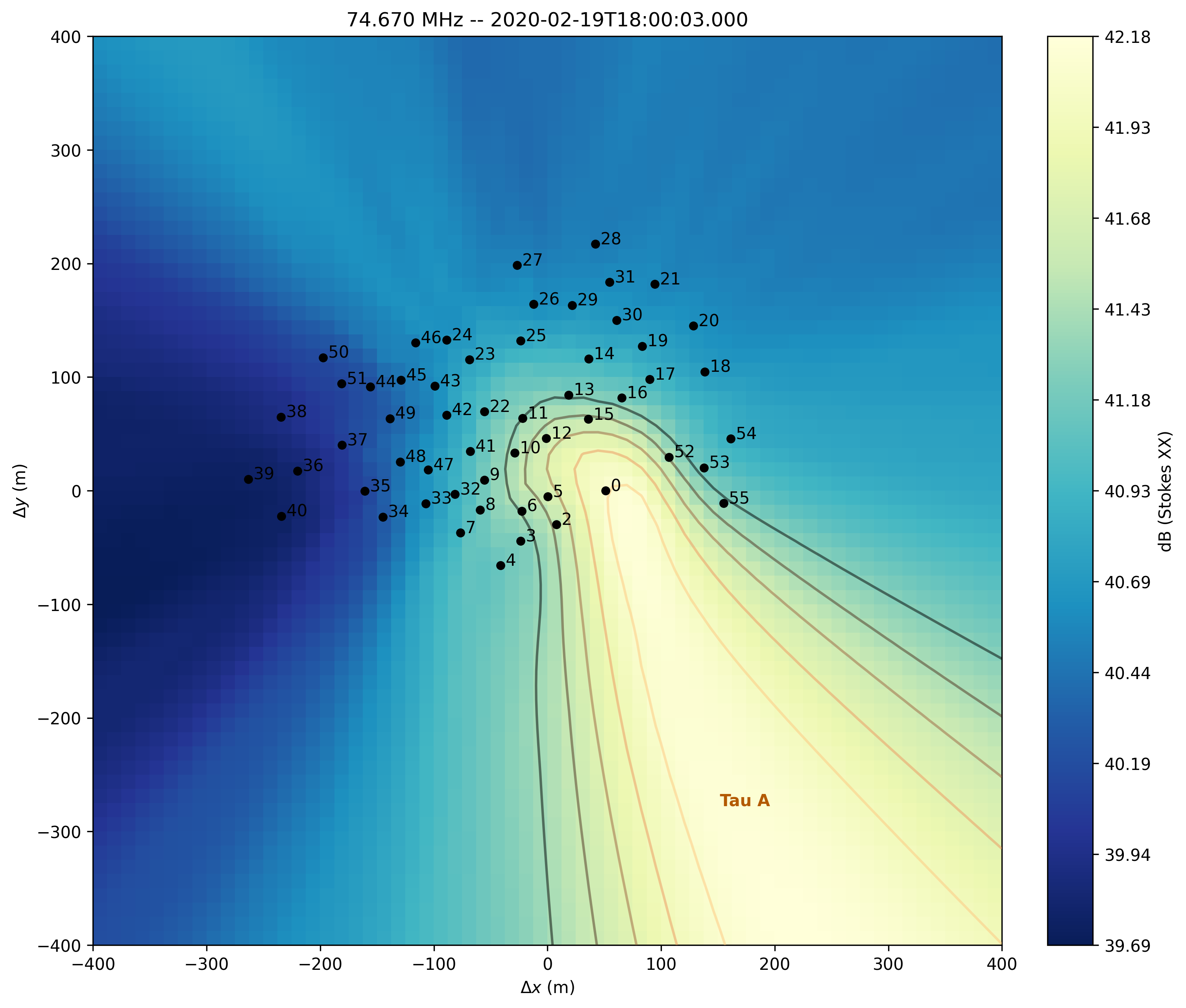
nenupy.io.xst.TV_Nearfield
- class nenupy.io.xst.TV_Nearfield(nearfield, source_imprints, npix, time, frequency, radius, mini_arrays, stokes)[source]
Bases:
objectClass to handle NenuFAR TV nearfield storage and display.
- __init__(nearfield, source_imprints, npix, time, frequency, radius, mini_arrays, stokes)[source]
Produce an instance of
TV_Nearfield.- Parameters:
nearfield (
ndarray) – The Near-field map to display, image must be squaresource_imprints (
dict) – Dictionnary of Near-field imprints from radio sources, each imprint must be of same shape as the main near-field imagenpix (
int) – Side pixel width of the nearfield imagetime (
Time) – Average time of the near-field data acquisitionfrequency (
Quantity) – Average frequency of the near-field data acquisitionradius (
Quantity) – Ground radius of projected near-fieldmini_arrays (
ndarray) – Mini-Arrays indices used to compute the near-fieldstokes (
str) – Stokes parameter represented
- Raises:
ValueError – Raised if nearfield is not square, or source_imprints do not match nearfield, or npix does not match the nearfield dimensions
Example
>>> from nenupy.io.xst import XST
>>> from nenupy.io.xst import TV_Nearfield
>>> xst = XST(".../nenupy/tests/test_data/XST.fits")
>>> xx_data = xst.get(polarization="XX")
>>> nearfield, src_dict = xx_data.make_nearfield(
        radius=400*u.m,
        npix=64,
        sources=["Tau A"]
    )
>>> tv_nf = TV_Nearfield(
        nearfield=nearfield,
        source_imprints=src_dict,
        npix=nearfield.shape[0],
        time=xst.time[0],
        frequency=xst.frequencies[0],
        radius=400*u.m,
        mini_arrays=xst.mini_arrays,
        stokes="XX",
    )
Methods
__init__(nearfield, source_imprints, npix, ...)Produce an instance of
TV_Nearfield.from_fits(file_name)Load a nearfield previously stored in a FITS file.
save_fits(file_name)Save a near-field made from NenuFAR-TV data as a FITS file.
save_png([figname, fig, ax, figsize, ...])Display the near-field image.
- classmethod from_fits(file_name)[source]
Load a nearfield previously stored in a FITS file.
- Parameters:
file_name (
str) – Path to the FITS file containing a near-field image (whose format is such as created by thesave_fits()method).- Returns:
Instance of
TV_Nearfield.- Return type:
Example
>>> from nenupy.io.xst import TV_Nearfield
>>> nf = TV_Nearfield.from_fits("/path/to/nearfield.fits")
- save_fits(file_name)[source]
Save a near-field made from NenuFAR-TV data as a FITS file.
- Parameters:
file_name (
str) – Name of the file to save
Example
>>> from nenupy.io.xst import NenufarTV
>>> tv = NenufarTV("20191204_132113_nenufarTV.dat")
>>> nf_object = tv.compute_nearfield_tv(sources=["Cyg A", "Cas A", "Sun"])
>>> nf_object.save_fits(file_name="/path/to/nearfield.fits")
- save_png(figname='', fig=None, ax=None, figsize=(10, 10), decibel=True, cmap='YlGnBu_r', vmin=None, vmax=None, cbar_label=None, title=None)[source]
Display the near-field image.
- Parameters:
figname (
str, optional) – Name of the figure, if given the figure will be saved, by default “”fig (
Figure, optional) –matplotlibfigure instance, by defaultNoneax (
Axes, optional) –matplotlibax instance, by defaultNonefigsize (Tuple[
int,int], optional) – Size of the figure, by default (10, 10)decibel (
bool, optional) – Set the scale of the data displayed to dB (i.e., \({\rm dB} = 10 \log_{10}({\rm data})\)), by default Truecmap (
str, optional) – Color map used to represent the data, by default “YlGnBu_r”vmin (
float, optional) – Minimal value displayed, by defaultNone(i.e., overall minimal value)vmax (
float, optional) – Maximal value displayed, by defaultNone(i.e., overall maximal value)cbar_label (
str, optional) – Label of the color bar, by defaultNone(i.e., automatic label)title (
str, optional) – Title of the plot, by defaultNone(i.e., automatic label)
Example
>>> from nenupy.io.xst import XST, TV_Nearfield

>>> xst = XST(".../nenupy/tests/test_data/XST.fits")
>>> xx_data = xst.get(polarization="XX")
>>> nearfield, src_dict = xx_data.make_nearfield(
        radius=400*u.m,
        npix=64,
        sources=["Tau A"]
    )
>>> tv_nf = TV_Nearfield(
        nearfield=nearfield,
        source_imprints=src_dict,
        npix=nearfield.shape[0],
        time=xst.time[0],
        frequency=xst.frequencies[0],
        radius=400*u.m,
        mini_arrays=xst.mini_arrays,
        stokes="XX",
    )
>>> tv_nf.save_png(figname="")