nenupy.io.tf_utils.de_faraday_data
- nenupy.io.tf_utils.de_faraday_data(data, frequency, rotation_measure)[source]
Correct the data from Faraday Rotation effect.
Linearly polarized light travelling through a magnetized plasma is subject to a rotation of its polarization direction due to charged particles (mostly dominated by electrons) reacting to and influencing differentially the magnetic field components of the electromagnetic radiation.
This function computes the chromatic Faraday rotation angle to correct for \(\theta (\nu)\) with
faraday_angle(), given therotation_measureof the intervening plasma. It is equivalent as computing \(\Delta \theta = | \theta (\nu_{\rm ref}) - \theta (\nu) |\), i.e., the difference of rotation angle where everyfrequencyis compared to an ‘infinite’ frequency (since \(\theta \propto \nu^{-2}\)).\[\mathbf{d}_{\rm corrected}(t, \nu) = \mathbf{R}(\nu) \mathbf{d}(t, \nu) \mathbf{R}(\nu)^\top,\]where
\[\begin{split}\mathbf{R}(\nu) = \begin{pmatrix} \cos \theta (\nu) & - \sin \theta (\nu) \\ \sin \theta (\nu) & \cos \theta (\nu) \end{pmatrix}\end{split}\]is the Faraday rotation matrix and
\[\begin{split}\mathbf{d}(t, \nu) = \begin{pmatrix} e_{\rm x}\overline{e_{\rm x}} & e_{\rm x}\overline{e_{\rm y}} \\ e_{\rm y}\overline{e_{\rm x}} & e_{\rm y}\overline{e_{\rm y}} \end{pmatrix}(t, \nu),\end{split}\]and similarly \(\mathbf{d}_{\rm corrected}\) are the
dataand corrected data returned by this function, shaped as Jones matrices of the signal. \(t\) and \(\nu\) are the time and frequency.- Parameters:
- Returns:
Faraday rotation corrected data.
- Return type:
- Raises:
Exception – Raised if the data dimensions do not meet the requirements.
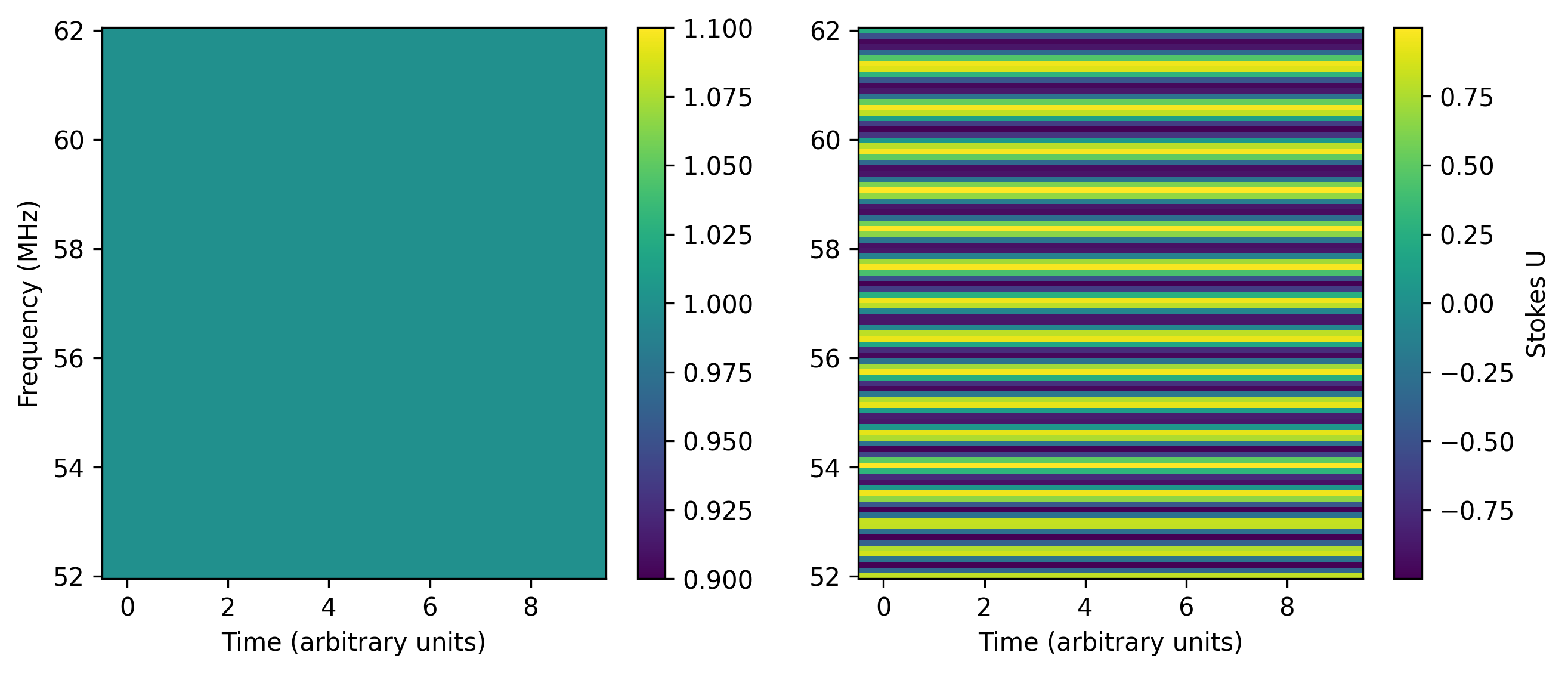
Examples
>>> import numpy as np
>>> import astropy.units as u
>>> import matplotlib.pyplot as plt
>>> from nenupy.io.tf_utils import de_faraday_data

>>> times = np.arange(10)
>>> frequencies = np.linspace(52, 62, 100) * u.MHz
>>> linearly_polarized_light = 0.5 * np.array([[1, 1], [1, 1]]) # 45 deg
>>> linearly_polarized_light = np.tile(linearly_polarized_light, (times.size, frequencies.size, 1, 1))
>>> stokes_u = linearly_polarized_light[..., 0, 1] * 2
>>> faraday_rotated_light = de_faraday_data(
        data=linearly_polarized_light,
        frequency=frequencies,
        rotation_measure=5 * u.rad / u.m**2
    )
>>> faraday_stokes_u = faraday_rotated_light[..., 0, 1] * 2

>>> fig = plt.figure(figsize=(10, 4))
>>> axes = fig.subplots(nrows=1, ncols=2)
>>> im_0 = axes[0].pcolormesh(times, frequencies.to_value(u.MHz), stokes_u.T)
>>> im_1 = axes[1].pcolormesh(times, frequencies.to_value(u.MHz), faraday_stokes_u.T)
>>> cbar_0 = plt.colorbar(im_0)
>>> cbar_1 = plt.colorbar(im_1)
>>> cbar_1.set_label(r"Stokes U")
>>> axes[0].set_ylabel("Frequency (MHz)")
>>> axes[0].set_xlabel("Time (arbitrary units)")
>>> axes[1].set_xlabel("Time (arbitrary units)")
See also